
by Matthew Russell - Posted 9 months ago
Welcome, my CryptoComics Compatriots. Have you ever started reading about a digital comic, hit a wall of strange words, and immediately felt like you weren’t the intended audience? If so, you’re not imagining things.
This space wasn’t always explained well. And a lot of the language you see didn’t come from collectors at all.
Let’s be upfront. Most of the language around digital collectibles comes from developers, not collectors. It was created to describe how systems work, not how comics are collected. Somewhere along the way, that language made its way directly to buyers without much translation.
That’s why it can feel cold, technical, or oddly financial. And when you’re here for comics, that disconnect can make you think, this isn’t for me. If the language feels weird, that’s normal.

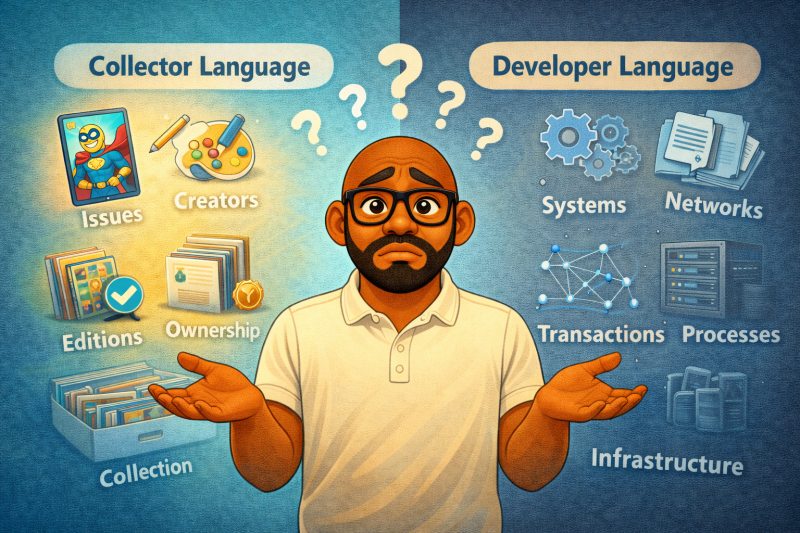
Collectors and developers think about things very differently. Collectors think in terms of: Issues, Creators, Editions, Ownership, and most importantly Completing a collection.
Developers think in terms of: Systems, Networks, Transactions, Processes, as well as Infrastructure.
Neither is wrong. But problems happen when developer language is dropped into a collector space without translation. Think about it in terms of “left brain” being more analytical, and “right brain” being more artistic.

So let’s slow down and translate a few of the terms you’re most likely to see. A few words that sound scarier than they are.
You’ll sometimes hear people use another term for this such as NFTs, but we stick with digital collectibles for a reason. All this means is: a specific comic you can own digitally.
Not a subscription.
Not access.
A collectible.
This one sounds financial, and that alone can raise anxiety. This is simply about how you pay, not what you’re buying. Whether you use traditional money or cryptocurrency doesn’t change the comic, the creator, or what you own. It’s a checkout choice, not a collecting philosophy. Think of Fiat as the traditional money and cryptocurrency as digital money.
Just like all the other terms on this list, there are more intricacies that will set them apart, but if you get the basics, you can understand what they are pretty well.
A wallet is just how ownership is associated with you. You don’t need to understand how it works internally to collect. Think of it like the place your proof of ownership is tied to, not a thing you’re constantly fiddling with.
You don’t need to “be good at wallets” to be a collector.
Another way to think about a wallet is this: it’s not something you “use” all the time, it’s something that quietly exists in the background. Most collectors interact with the comic itself, not the wallet. The wallet is simply how the system knows which comics belong to you.
You don’t open it to read. You don’t manage it every day. In many ways, it’s closer to a name on a receipt or a record in a filing cabinet than it is to a tool you’re expected to master.

When people talk about a “network,” they’re not talking about the comic itself. They’re talking about the underlying system that keeps track of ownership. Think of it like the infrastructure behind the scenes.
The network is the place where the record of ownership lives, not where the story, art, or reading experience lives.
The CryptoComics Marketplace currently uses POL as its network because it strikes a good balance between reliability, efficiency, and accessibility. In simple terms, POL allows ownership to be recorded in a way that’s stable and practical without making the experience feel heavy or expensive for collectors.
The choice wasn’t about hype or trends. It was about starting with a network that works well for comics and collectors right now.
It’s also important to know that POL isn’t the final destination. As the platform grows, additional networks will be added over time. The goal is flexibility, not lock-in. The network is just the rails the comic travels on, and those rails can expand. What matters most stays the same: the comic, the creator, and your ownership of what you collect.
You don’t need to compare networks or understand how they’re built to collect here.
The reason you keep seeing these words isn’t because you’re expected to become technical, or because you’re supposed to already understand them. It’s because digital collecting didn’t start with collectors.
It started with people building the systems first.
Before comics, before art, before collectors showed up, developers had to invent ways for digital ownership to exist at all. To do that, they used the language they already knew. Software terms. Financial terms. Engineering terms.
Those words were useful for building the foundation, but they were never meant to be customer-facing language.
Then comics entered the picture.
Instead of translating that language into something familiar for collectors, a lot of platforms simply passed it along as-is. The result is what you see today: perfectly functional systems explained in ways that feel cold, confusing, or disconnected from the joy of collecting.
That gap isn’t your fault.
Now collectors are part of the conversation. That’s a good thing. It means the focus is shifting from how the system works to how people actually use it. But language takes time to catch up. Until it does, translation matters.
The goal isn’t for collectors to become developers. It’s for the language to meet collectors where they already are.
Here’s the part I want to be very clear about. You don’t need to learn all of this to collect. You don’t need to master the language. You don’t need to memorize terms. You don’t need to understand how the systems work behind the scenes.
What matters is that when you see a tech word, you don’t panic. You can pause, keep reading, or ask a question instead of closing the tab.
If the language feels weird, that’s normal.
And if a word still trips you up, you’re allowed to ask about it.
There are no dumb questions here. Confusion is not a failure. It’s just a signal that the explanation needs to be better.
You can always reach out to us directly, or join the conversation on our Discord. That space exists so collectors can talk like collectors, not developers.

Next time, we’ll talk about why digital collectibles sometimes have extra steps, and why those steps exist in the first place. For now, it’s enough to know this:
Just remember, if the words feel unfamiliar, it doesn’t mean this space isn’t for you. It just means the language hasn’t caught up yet. That’s something we can fix together.

